The Best Great Barrier Reef Vacations, Luxury Hotels
Great Barrier Reef Dive Resorts, Tours, Travel Packages
The Great Barrier Reef is pure enchantment. Not only does it delight the senses but it casts a spell over all who enter. Stretching through the sapphire blue waters of Queensland for over 2000 kilometres, the Great Barrier Reef is the most extensive coral reef system in the world.
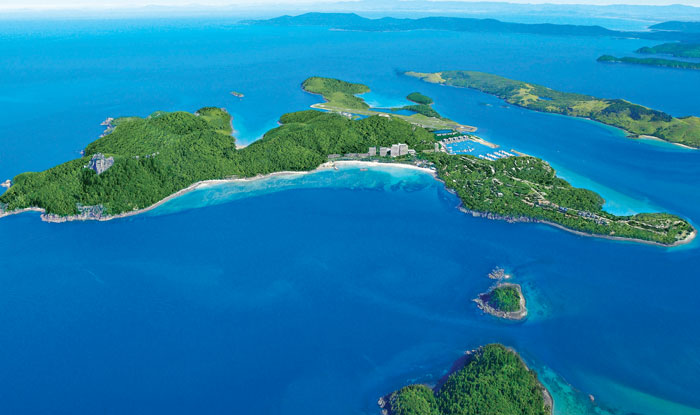
From Bundaberg in the south, to beyond Cape York in the Tropical North Queensland Region , it is also the largest World Heritage area, and the largest structure made completely by living organisms. The Great Barrier Reef is not a single reef, but features more than 2900 individual reefs and 900 islands. Some of these islands are deserted while others are small bare sand cays, permanently vegetated cays and continental islands.
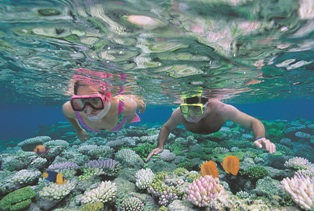
The warm waters off Queensland offer some of the best boating and diving in the world. Diving the Great Barrier Reef will introduce you to a fathomless underwater world and thousands of brilliantly coloured species of marine life including 1500 types of fish, 4000 types of molluscs, 350 types of echinoderms and 350 types of corals. This diversity creates a kaleidoscope of colour for divers, snorkellers, and people viewing from underwater observatories and glass-bottomed boats. Average water temperatures on the reef range from around 22 C in July to around 27 C in January making it perfect for diving all year round.
The Reef is also the breeding area for a number of rare and endangered species. Humpback whales swim up from the Antarctic to give birth to their young in our reef waters. Six of the world's seven species of sea turtle breed on the Reef, and dugong make their home among the sheltered seagrass beds.
The Reef region is one of Australia's major tourist destinations. High-speed catamarans will take you to isolated areas which were previously only seen by a privileged few. To ensure this precious and fragile natural attraction is preserved, tour operators have to observe guidelines relating to the number of tourists and the activities enjoyed.
Whether you sail, snorkel, dive or swim, the Reef is a marvellous place for recreation.
Please note:
An Environmental Management Charge (ECM) is levied by the Australian Government for all adults and children four years and over entering the Great Barrier Reef World Heritage area, to assist in the preservation of this natural wonder. The EMC is currently A $4 per person per day, to a maximum of A $12 per person. Please check with your travel agent for payment collection details at the time of booking.
Following below is a report on the status of the Reef in 1998
STATUS OF THE GREAT BARRIER REEF WORLD HERITAGE AREA 1998
This is a summary of the first ever report on the state of the Great Barrier Reef World Heritage Area prepared by the Great Barrier Reef Marine Park Authority. The report indicates that most of the Reef's attributes are in good shape but recognizes the need for long term analysis.
Impacts on the Reef's environmental attributes include:
Cyclones and floods are one of the most common sources of natural impact on coral communities. Physical disturbance and recovery are natural phenomena on the Great Barrier Reef and play an important part in determining the abundance and species composition of coral communities.
Crown-of-thorns starfish outbreaks also impact on corals. However, most scientific evidence suggests that crown-of-thorns outbreaks are a natural phenomenon. Outbreaks may have occurred on the Great Barrier Reef for the last 3000 to 7000 years.
Coral bleaching occurs when corals become stressed and eject brownish coloured algae. The main cause is believed to be elevated water temperature, high levels of sunlight and low salinity. Coral bleaching mainly occurs in inshore reefs. Bleached corals are not dead and, if they are not severely stressed, can make a full recovery. There has been no scientific link established between greenhouse gases and coral bleaching.
MANAGEMENT OF THE REEF
Management responsibility lies with the Great Barrier Reef Marine Park Authority (GBRMPA), established in 1975 to advise the Commonwealth Government on the care and development of the Great Barrier Reef Marine Park.
Together with other government agencies, including Tourism Queensland, GBRMPA is actively addressing issues relating to potential human impact and developing measures to ameliorate these impacts.
All tourism operators using the Reef require a permit. Codes of practices, training and education are becoming increasingly important for management purposes.
The strict management practises for the Reef prohibit the dumping of effluent and waste products.
Tourist pontoons in the Great Barrier Reef are fully self-contained and permanently anchored which means they are not causing anchor damage.
Visitors can assist in managing human impacts on the Reef by avoiding direct contact with coral. Guides often accompany visitors to encourage appropriate behaviour.
ENVIRONMENTAL ATTRIBUTES
There are 14 known environmental attributes to the Reef. Changes to the status of these attributes, specifically corals and crown-of-thorns starfish, frequently attract negative media coverage which can impact on the tourism industry.
According to the Status of the Great Barrier Reef World Heritage Area 1998 report, there are no major widespread declines in relation to these attributes.
However, all environmental attributes vary naturally over time. Long term monitoring is in progress and the second edition of this report, to be published in 2003, will provide a more definite indication of human impact on the reef.
To ensure the sustainability of the Reef, the GBRMPA has a range of management measures in place.
WHAT IS THE GREAT BARRIER REEF WORLD HERITAGE AREA
The Great Barrier Reef World Heritage Area is the largest in the world and one of the few World Heritage Areas which meets all four natural World Heritage criteria. The Reef was World Heritage listed in 1981 in recognition of its outstanding universal value.
It is the largest of the world's 552 World Heritage Areas, covering 347,800 km(. It is larger than the states of Victoria and Tasmania combined. There are more than 2800 catalogued reefs in the area.
TOURISM ON THE REEF
Tourism is a key industry in the Great Barrier Reef World Heritage Area, with an approximate annual value in excess of $1 billion.
Visitor-days on the reef: 1997 1.6 million visitor-days 1980s 150 000 visitor-days This represents a 40-fold increase since the 1940s.
Commercial operators conduct about 1.3 million scuba dives per annum.
In 1998, a total of 742 tourism operators had permits to operate in the Marine Park.
Most of the Reef tourism is concentrated in two areas, offshore from Cairns and the Whitsundays, which cover only five per cent of the Marine Park.
The Great Barrier Reef Marine Park Authority is developing a Reef-wide approach to managing tourism use throughout the whole of the Marine Park.
Source: State of the Great Barrier Reef World Heritage Area 1998, Great Barrier Reef Marine Park Authority.
Travelwizard.com's founder has dived for 30 years extensively on the Barrier Reef, as well as all the Whitsunday Islands and the South Pacific Islands, and specializes in scuba diving vacations. Click on our, "Vacation Planner" to begin your vacation.
Remember--You will save Time, Money and Stress when you book your trip with our Virtuoso Australia Specialists.
The Great Barrier Reef resort prices you see on this site are published fares--ours are often 10 to 50% less. Use our vacation planner or call us at 1 800 330 8820 or 1 415 446 5252 for our exclusive up-to-the-minute specials.
|