|
Costa Rica, meaning "rich coast" in Spanish, has a land area of 51,100 square kilometers and is slightly smaller than Switzerland, a country with which it is often compared. Its 3.5 million inhabitants (an average population density of 67 people per square kilometer) are ethnically homogenous but live in a country that varies greatly from one area to another. In the north the Rio San Juan forms most of the 300-kilometer-long border to Nicaragua. The border to the south and southeast separates Costa Rica from Panama. The vast La Amistad National Park is shared by the two countries and spreads out on both sides of the border. The 200-kilometer-long Caribbean coast is to the east and the 1,000-kilometerlong Pacific coast is to the west.
Topography
Costa Rica can be divided into three major topographic areas: The Cordilleras (mountain chains), which are of volcanic origin, the alluvial Caribbean Lowland Plains and the hilly Pacific Region.
The Cordilleras
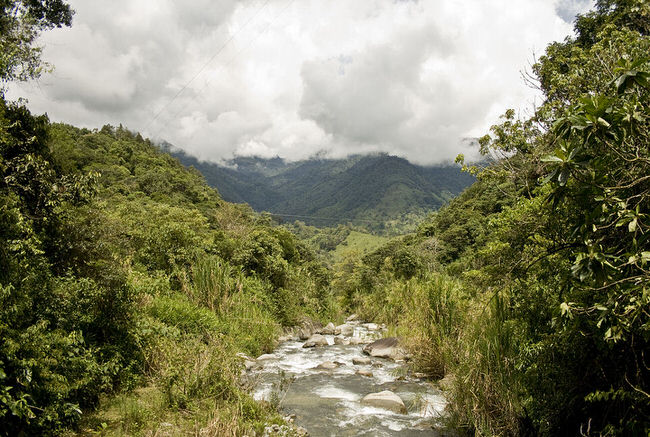
The Cordilleras run from the northwest to the southeast of the country and consist of four mountain chains. The Cordillera de Guanacaste stretches from the Nicaraguan border to Lake Arenal. The Tenorio (1,916 m), Rincon de la Vieja (1,096 m), Orosi (1,487 m) and Arenal (1,633 m) volcanoes make up the vertebrae of its spinal column. The Cordillera de Tilaran includes the cloud forest preserve of Monteverde, and reaches heights of up to 1,500 meters. The 70kilometer-long Cordillera Central rises to its highest altitude at the inactive Pods volcano (2,704 m), and contains other dormant volcanoes. Costa Rica's four major cities: San Jose, Alajuela, Cartago and Heredia are situated between 1,000 and 1,500 meters altitude in the part of the Cordillera Central known as the Meseta Central (Central Plateau).
Finally, there is the Cordillera de Talamanca, a massive mountain chain made of fold mountains (not of volcanic origin) which contains the highest peak in Costa Rica, the Cerro Chirripo (3,820 m). From its summit the view spreads in all directions, taking in many mountains rising more than 3,000 meters skyward. The densely populated Cordillera Central separates the Cordillera de Talamanca from the Cordillera de Tilaran.
The Caribbean Lowland Plains
Banana plantations form the center of the Atlantic region or region Atlantico. Numerous lagoons and swamps, along with the Tortuguero National Park, make up the northern and western parts of this region. In the southeast, near the border to Panama, lies an enormous park, La Amistad, made up of vast areas of virgin jungle. Further west the forest becomes flatter and thicker.
The Pacific Region
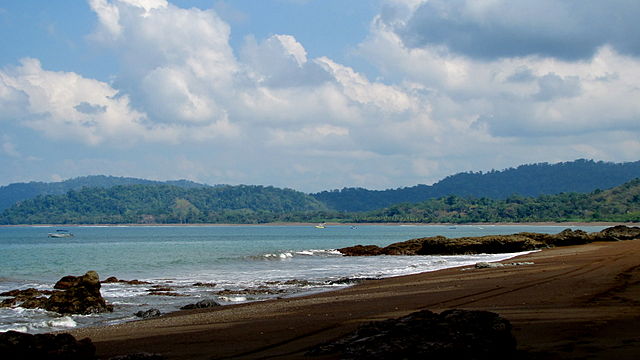
The third area is the Pacific Region to the west. Great plains dominate the northern part where the historically important Santa Rosa National Park is located. This is also where the fertile valley of the Rio Tempisque, which is so vital to the country, is located. In the south is the dry Peninsula de Nicoya, with its wide valleys and hills reaching up to 1,000 meters skyward. The coastal lowlands become narrower in the central Pacific Region and end at the southern tip of the Peninsula de Osa. Huge commercial banana plantations have replaced the virgin rain forest that once covered the southern Pacific Region of Costa Rica, surrounding the harbor town of Golfito.
Climate
Costa Rica has two rather than four seasons: the rainy season and the dry season. The dry season, known to the native inhabitants as verano (summer), lasts from December to April, during which it rains only once or twice a month. The rainy season, invierno (winter), lasts from May through November. The heaviest rainfall occurs during September and October, and supplies a large share of the country's annual rate of precipitation.
The Atlantic coast averages 20 rainy days per month, while the variable weather of the Pacific coast means fewer days of continuous rain, but more frequent tropical showers (aguaceros). Costa Rica ranks among the world's 10 rainiest regions.
Temperatures on the coast range from 20°C during the night to 30-35°C during the day. Primavera eterna (eternal spring) dominates the weather in San Jose, and in the Alajuela region where it is seldom cooler than 15°C at night or hotter than 26°C during the day.
The exception is the summits of the volcanoes, where cooler temperatures, due to the high altitudes, are the rule, especially at night or on cloudy afternoons when it can be surprisingly chilly.
The amount of annual precipitation varies from region to region. San Jose averages 2,000 mm annually (about three times the average of central Europe), while the Caribbean port city of Puerto Limon has twice as much rain, averaging 4,000 mm a year. Certain national parks and tropical rain forest preserves have twice as much precipitation, producing high humidity throughout the year.
|